
INVESTIGATION | RESPONSIBILITY & RISK
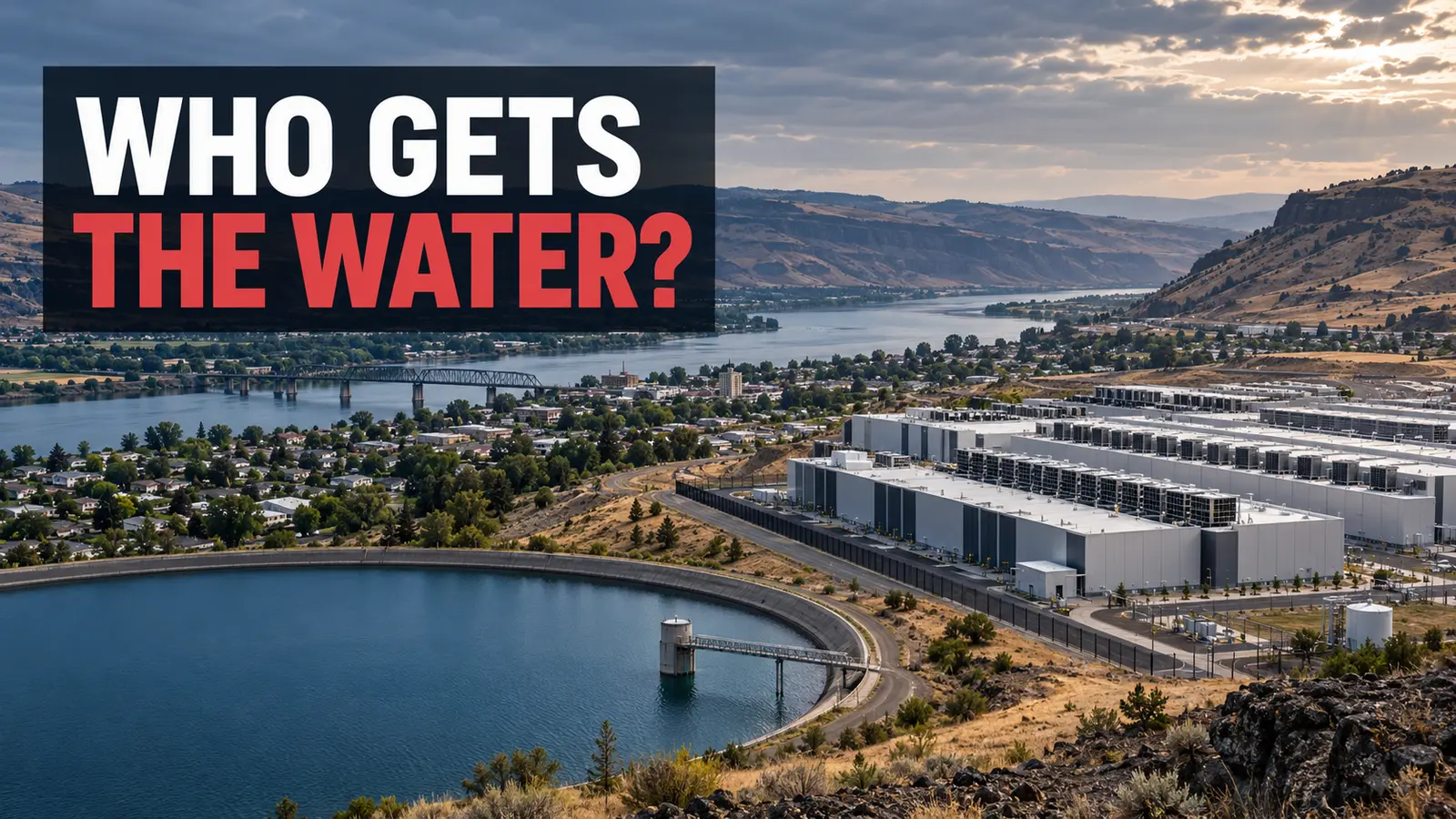
Google’s data centres used about one-third of the water consumed in The Dalles, Oregon, in 2024. The company has helped fund the city’s water system. The city says its long-term water plans are for the whole community. The unresolved question is what rules protect that community as one customer’s demand continues to grow.
In The Dalles, Oregon, a question about artificial intelligence has become a question about water.
Google opened its first data centre in the city in 2006. By 2024, its three local sites were using about one-third of all the water consumed through the city system.
That year, Google used 434.4 million gallons. That is about 1.19 million gallons a day.
The figure does not prove that one-third of the city’s water was used for AI. Google’s facilities support many computing services, and the public record does not identify what share of their local workload is related to AI.
But the physical infrastructure supporting the wider digital and AI economy is expanding. Google completed another building in The Dalles in 2025 and was expected to complete another in 2026.
The public question is therefore no longer whether the company uses a significant amount of water. It is who decides how much more water can be committed, what evidence must be public, and whose needs take priority when supply tightens.
The number grew while the city changed around it
Google’s local water use was about 104 million gallons in 2012, equal to roughly 12 per cent of the city total. By 2024, it had risen to 434.4 million gallons and about one-third of city consumption.
The Dalles grew too, but more slowly. Portland State University estimates cited by Oregon Public Broadcasting put the city’s population at about 16,200 after an increase of roughly 1,700 people over 15 years.
These figures do not establish that Google caused every change in the city’s water planning. They do establish that its demand is now too large to be treated as a minor industrial detail.
Google is the city’s largest water customer. Its current annual use is close to the one million gallons a day assigned in the city’s 2024 master plan to a future unnamed industrial user. The city says that user is not Google.
That distinction matters. Immortal AI has found no public evidence proving the unnamed user is Google, and the article should not imply otherwise.
It also leaves a wider question. If the city is planning for another industrial customer of similar scale while Google’s existing campus is still expanding, has the public seen a complete cumulative test of future demand?
The city’s case is stronger than a simple corporate giveaway story
The City of The Dalles rejects the claim that its watershed plans are being driven by Google.
It says long-term reservoir expansion was considered decades before data centres arrived. Its current watershed proposal would transfer about 150 acres of federal land surrounding the Crow Creek reservoir and related infrastructure to the city.
The city says the proposal does not expand its water rights, authorise construction or create a dedicated water supply for any private company. Any future reservoir work would require separate environmental review, permits, Tribal consultation and public engagement.
The city also says its municipal watershed provides around 70 to 80 per cent of annual supply and that long-term planning must address population growth, reduced snowpack, drought and wildfire risk.
Those are legitimate public responsibilities.
Google has also contributed material infrastructure. The city says the company paid normal industrial water rates, transferred water rights, funded an aquifer storage and recovery system, and delivered about $28.5 million in publicly owned improvements including wells, reservoirs, a pump station and a sewer lift station.
Those contributions complicate the story. They can improve public capacity and reduce the amount other customers must fund. They can also deepen the city’s dependence on a customer whose future demand is commercially important to both parties.
Paying for infrastructure is not the same as proving that future allocation is fair, resilient or transparent.
The dispute is about purpose, not only volume
The city says the watershed land transfer and possible future reservoir expansion serve the whole community. Mayor Richard Mays told OPB that Google was “really not a factor” in the proposal.
Environmental groups and some residents are not convinced. They point to Google’s growing use, the planned campus expansion and the ecological importance of the Dog River system for threatened fish.
The proposed legislation itself would not increase withdrawals. The harder question comes later: what additional storage may be built, what water would fill it, what environmental conditions would apply, and how future supply would be allocated among homes, public services, existing businesses and large industrial customers.
This is where a public decision can become difficult to examine.
The city operates one municipal system. Water added to that system may benefit the whole community. It can still be planned, financed or reserved around the needs of a very large customer.
The correct test is not whether a project has Google’s name on it. It is whether the decision records show what demand drove the project, who receives reliable access, who pays, what happens in drought, and whether approval reopens when demand changes.
The records were once treated as a trade secret
Public trust is also shaped by how the one-third figure became known.
The City of The Dalles initially refused a public-records request for Google’s local water use and argued that the information was a trade secret. After the Wasco County district attorney ordered disclosure, the city filed proceedings seeking to prevent release.
The dispute ended in a settlement. The city agreed to disclose a decade of Google water-use records and similar annual information in response to future requests. Google later said it would no longer seek to protect site-level water figures as trade secrets.
The records then showed how concentrated the demand had become.
This history does not prove that current city statements are wrong. It does explain why assurances alone are insufficient.
A community should not need litigation to learn how much of a shared resource is being used by its largest customer.
One-third is serious, but it is not a universal data-centre number
The Dalles should not be used to claim that every data centre consumes one-third of its host city’s water.
Hillsboro, also in Oregon, reported that its data centres used about 111 million gallons in 2025. That was 1.76 per cent of total city demand.
Virginia’s legislative audit found another pattern. Data centres used less than 0.5 per cent of statewide withdrawals in 2023, but at six utilities reviewed they accounted for between 2 and 21 per cent of system use when reclaimed water was excluded.
The contrast is the lesson.
National and statewide percentages cannot decide whether a particular city, aquifer or watershed can absorb a project. Cooling design, climate, project scale, source water, reclaimed-water capacity and competing demand all change the result.
A corporate water-positive target cannot answer that local question either. Replenishment elsewhere may have value, but it does not guarantee water in the host community during a hot summer or drought.
What a defensible decision would show
The Dalles dispute points to a standard that should apply before any community commits land, incentives or infrastructure to a large data-centre project.
The public record should show:
- The project’s average, peak-day and peak-season water demand.
- The water source, legal entitlement, spare capacity and competing committed uses.
- Cumulative demand from every existing, approved and reasonably foreseeable large customer.
- The cooling design, expected direct consumption and the trade-off between water and electricity.
- Drought rules identifying who must reduce use, when restrictions begin and whether drinking water can become a fallback supply.
- The cost and ownership of new wells, reservoirs, treatment, pipes and monitoring.
- Actual facility-level use reported at least annually, with enough detail to test projections.
- Enforceable limits, audit rights and a requirement to reconsider approval if the project or its demand changes materially.
This is close to the approach Texas adopted in August 2026. Its governor directed regulators to obtain projected annual and peak water consumption, supply sources and cooling technology before data-centre projects could move forward through the grid-connection process.
The Texas process is new and its effectiveness remains untested. Its importance is the decision gate: provide the evidence before approval, not after the infrastructure is committed.
Who decides what comes next?
The Dalles does not present a simple choice between a technology company and household taps.
Google pays for the water it uses. It has transferred assets and water rights to the city. The city has long-standing reasons to plan for drought, growth and wildfire. The data centres also bring jobs, tax revenue and economic activity.
But payment does not settle priority.
When one customer uses about one-third of a city’s water, its future demand becomes a public governance issue. Decisions about added storage, new supply and drought protection can affect residents, other industries, future housing, downstream users and ecosystems for decades.
The people making those decisions should be publicly accountable. The evidence should be disclosed before commitments are locked in. The agreement should say what happens when the assumptions fail.
If the city is right that future water projects serve the whole community, transparent cumulative modelling and enforceable allocation rules should help demonstrate that.
If those records remain incomplete, the public is being asked to trust a conclusion it cannot test.
What communities can do now
- Ask the utility for the largest industrial users’ annual and peak demand, subject only to narrow security or privacy redactions.
- Request a cumulative water assessment covering existing, approved and proposed data centres and other major users.
- Separate infrastructure that is funded and operational from future promises, replenishment targets and voluntary goals.
- Require drought, expansion and project-delay scenarios before approvals or public spending are final.
- Record who pays, who owns the assets, who receives priority and what triggers a new public decision.
Use the Data Centre Community Hub to structure the evidence request and record what remains unanswered.
The question is not whether Google should receive water
A city can decide that a data centre’s economic and infrastructure benefits justify substantial water use.
That decision should be made openly, using local evidence and enforceable rules.
The Dalles shows why averages and sustainability pledges are not enough. A company can pay its bills, fund infrastructure and still become large enough to reshape the choices available to everyone else.
Google used about one-third of the city’s water in 2024. The next question is not whether that number sounds large.
It is what the city has promised, what the company can ask for next, and what protection remains for the people and places sharing the same supply.
Continue the investigation
This article extends Immortal AI’s Data Centre Community Impact investigation. Read AI’s Buildings Are Private. The Costs Do Not Always Stay That Way and Meta Needed a Data Centre. BlackRock Found the Money. Who Carries the Risk? for the wider questions of infrastructure costs, finance and responsibility.
For practical tools, evidence questions and the host-community decision framework, visit the Data Centre Community Hub.
Sources
City of The Dalles: The Dalles Watershed Act, what you need to know
City of The Dalles: Google’s contributions to the city water system
Reporters Committee for Freedom of the Press: Settlement over Google water-use records
Virginia JLARC: Data Centers in Virginia
City of Hillsboro: Data Center Water Use
Office of the Texas Governor: Comprehensive data-centre audit direction
Lawrence Berkeley National Laboratory: US Data Center Energy Usage Report
Editorial note: The one-third figure refers to Google’s share of water consumed through The Dalles city system in 2024. It does not establish what share supported AI workloads. The city’s stated reasons for the watershed proposal and Google’s infrastructure contributions are included. Disputed claims are identified as disputed.
Editorial disclosure: Immortal AI uses AI-assisted research and drafting. Material claims were checked against city records, government reports, court-related records and detailed local reporting. Final editorial decisions remain the responsibility of Immortal AI.
Leave a Reply