
Category: Power & Infrastructure

Data centres, energy, water, finance, ownership, public costs and the physical systems supporting artificial intelligence.

  • Data Centre Tax Breaks: How Many Jobs Are Actually Permanent?

    Data Centre Tax Breaks: How Many Jobs Are Actually Permanent?

    INVESTIGATION | POWER & INFRASTRUCTURE

    Official evaluations often combine temporary construction work, permanent operations roles, contractors and modelled spillovers when describing the employment created by data centres.

    By Andrew McDonald · Immortal AI

    Data centres create substantial construction employment, but far fewer permanent operating jobs. Virginia estimates illustrate the difference: approximately 1,500 workers during peak construction compared with around 50 full-time roles at a typical operating facility.

    The problem is not that data centres create no work. They do. The problem is that “jobs” can mean several different things: a temporary construction workforce, permanent employees inside the facility, contractors who service it, and jobs estimated elsewhere in the economy. Those categories describe different public benefits, but incentive debates often present them as if they were interchangeable.

    The number changes when the clock changes

    Virginia’s legislative oversight agency, JLARC, estimated that data centres supported about 74,000 jobs annually, including direct, indirect and induced employment. About 59,000 were associated with construction and 15,000 with operations. Of the operations total, about 4,400 were direct jobs.

    The difference is easier to see at the scale of one facility. JLARC reported that a typical 250,000-square-foot data centre may employ about 50 full-time workers once operating, roughly half of them contractors. At peak construction, the same project may put about 1,500 people on site for 12 to 18 months.

    Both figures matter. Construction jobs can be valuable, well paid and locally significant. But they are not the same promise as decades of permanent employment. A public claim that combines them should say so plainly.

    The tax benefit is easier to count

    Virginia’s retail sales and use tax exemption delivered about US$928 million in tax savings to the data-centre industry in fiscal year 2023, according to JLARC. About 90 percent of the industry used the exemption. The public cost was therefore concrete enough to estimate. The employment return required more interpretation: which phase, which employer, which geography and which economic model?

    Georgia shows the same tension from another direction. Its programme sets investment and “quality job” thresholds that vary with county population. Depending on location, a qualifying project may need to create as few as five, ten or 25 quality jobs while investing between US$25 million and US$250 million. That structure may be intentional: data centres are capital-intensive rather than labour-intensive. But it also means the scale of the investment can dwarf the minimum direct-employment requirement.

    Would the project have happened anyway?

    The hardest question is causation. An incentive can coincide with a project without being the reason the project exists. Georgia’s 2025 evaluation estimated that only 30 percent of data-centre construction activity was attributable to the exemption; in its model, 70 percent would have occurred without it. That estimate is not a universal fact about every project. It is an analytical assumption used to test the programme’s effects, and it should be read as such.

    The same evaluation also illustrates why simple verdicts are misleading. It calculated a negative direct fiscal impact for state government while estimating positive economy-wide value added. A concession can therefore look costly in the public ledger and beneficial in a broader economic model at the same time. The result depends on what is counted, over what period, and which benefits would not otherwise have occurred.

    A better public bargain

    Communities do not need a single magic jobs number. They need a public ledger that keeps unlike things separate. At minimum, incentive agreements and annual reports should distinguish construction jobs from ongoing jobs; employees from contractors; local hires from workers brought in temporarily; direct jobs from modelled indirect and induced effects; and commitments from outcomes.

    Reporting should also show duration, pay bands and the date on which each job count was measured. If a benefit depends on a minimum headcount, the public should be able to see whether the threshold was maintained. If the project misses the requirement, the agreement should explain whether tax benefits can be suspended, reduced or clawed back.

    Oregon’s enterprise-zone system offers a useful governance lesson: annual reporting and public-agreement requirements can make a promise more auditable. The exact design will vary by jurisdiction, but the principle is portable. The public should not have to infer performance from a ribbon-cutting announcement years after the tax treatment became certain.

    What residents can ask

    • How many jobs are construction, how many are permanent operations roles, and how long is each category expected to last?
    • How many roles are direct employees, contractors, local hires and modelled spillovers?
    • What wages, hours and benefits qualify a position to be counted?
    • Which figures are contractual commitments, which are forecasts, and which have been independently verified?
    • What happens if the investment or job thresholds are missed after the exemption has been claimed?

    The honest answer is not that every data-centre tax incentive is a bad deal. Some projects may broaden the tax base, support construction trades, improve infrastructure or generate wider economic activity. The honest answer is that those benefits should be tested against a clear counterfactual and reported in categories the public can understand.

    The tax break may be certain. The public return should be no less visible.

    Related Immortal AI investigations


    Principal sources

    AI disclosure: Immortal AI uses AI-assisted research and drafting. Sources, claims, framing and final editorial decisions remain the responsibility of Immortal AI.
  • AI’s Buildings Are Private. The Costs Do Not Always Stay That Way.

    AI’s Buildings Are Private. The Costs Do Not Always Stay That Way.

    NEWS & ANALYSIS | POWER & INFRASTRUCTURE

    Meta and BlackRock have created a $14 billion venture to build an AI data-centre campus in Texas. The deal shows how private capital is spreading the cost of the AI buildout. It does not answer who ultimately pays for power, water, tax concessions and stranded infrastructure.

    By Andrew McDonald · Immortal AI

    The artificial-intelligence boom is often described as a race between models. Its physical reality looks different.

    It requires land, concrete, servers, cooling systems, transmission lines, substations, water, roads and large amounts of finance. Before an AI system produces a single answer, someone must build the infrastructure that allows it to exist.

    On 28 July 2026, Meta and BlackRock announced a venture to develop and own a data-centre campus in El Paso, Texas. The project is expected to cost about $14 billion.

    BlackRock-managed funds will own 80 per cent. Meta will retain 20 per cent and contribute land and construction assets valued at about $2.3 billion. BlackRock will contribute about $4.9 billion in cash. Much of the structure will be financed through approximately $12.5 billion of debt.

    This is private finance at extraordinary scale. But “privately financed” does not necessarily mean every cost stays private.

    Immortal AI’s earlier analysis examined the Meta-BlackRock deal itself. This article follows the costs beyond the financing structure, into the grids, tax systems and communities that host the infrastructure.

    The first cheque is not the final burden

    The developer, operator, technology company, lender and investor may write the first cheques for a data centre.

    Other costs can travel through different systems. A utility may build new generation, transmission or distribution assets. A water authority may expand capacity. A council may provide roads, emergency services or planning staff. Governments may offer tax abatements or exemptions. Residents may experience noise, land-use conflict or pressure on scarce resources.

    Whether those costs reach households and taxpayers depends on contracts, tariffs, regulation and local conditions.

    It would be wrong to assume that every data centre raises household bills. It would be equally wrong to assume that a private project cannot shift risk onto the public.

    The real question is whether the people who benefit from the project are required to pay the costs it causes.

    The electricity scale is no longer marginal

    A Berkeley Lab report estimated that US data centres used 176 terawatt-hours of electricity in 2023, equal to 4.4 per cent of national electricity consumption.

    Its scenarios place 2028 demand between 325 and 580 terawatt-hours, or about 6.7 to 12 per cent of US electricity use.

    Those figures are estimates, not guarantees. They depend on accelerator shipments, utilisation, cooling, efficiency and the pace at which proposed facilities connect.

    The range itself is important. Utilities can be asked to plan expensive infrastructure years before final demand is known. If a project is delayed, reduced or cancelled after new assets are committed, someone still has to pay for what was built.

    A strong large-load tariff can place that risk on the applicant through upfront study payments, minimum bills, long contracts, credit support and exit charges. A weak arrangement can leave other customers carrying part of the stranded cost.

    Jobs are real. So is the difference between construction and operations

    Data centres create economic activity.

    Virginia’s Joint Legislative Audit and Review Commission estimated that the industry supported about 74,000 jobs and $9.1 billion in annual gross domestic product in the state during the period it studied. Most estimated employment came from construction rather than continuing operations.

    Several industry representatives told the commission that a typical 250,000-square-foot facility may employ around 50 full-time workers, about half contractors. That is an industry-reported benchmark, not a universal average.

    The distinction matters because public announcements often combine temporary construction work, indirect employment and permanent site jobs. All three can be valuable. They are not interchangeable.

    A community committing land, power, water or tax support needs to know which benefits remain after construction crews leave.

    Tax concessions are public spending through the tax code

    Governments often compete for data centres by exempting expensive servers, electrical equipment and other purchases from sales or use taxes.

    That can attract investment. It can also create a large public cost.

    Virginia’s legislative analysts reported that the state’s data-centre sales and use tax exemption accounted for $1.7 billion, or 42 per cent, of economic-development incentive spending over the decade examined in its 2024 report.

    That figure does not prove the exemption was bad policy. The correct comparison is what activity, tax revenue and strategic benefit occurred because of the concession, and what would have happened without it.

    But the cost must remain visible. A tax exemption is not free because no agency writes a cheque. It is revenue the public chooses not to collect.

    The same discipline should apply to property-tax abatements, discounted public land, infrastructure grants and special utility arrangements.

    Communities can receive large benefits

    The evidence is not one-sided.

    Where data-centre equipment and property are taxable, local revenue can be enormous. Mature clusters can fund schools, services and infrastructure at a scale few other land uses match.

    Construction can create well-paid work. Operations can provide skilled jobs and local contracts. Large customers can support new generation and spread fixed utility costs when tariffs are designed properly. Reclaimed water and less water-intensive cooling can reduce pressure on drinking supplies.

    These are genuine benefits. They are also location-specific.

    A result in a mature Virginia cluster cannot simply be applied to an arid Texas community, a constrained power market or a town offering a different tax structure.

    Who receives the upside?

    The Meta-BlackRock venture makes the ownership chain unusually visible.

    Meta will gain access to computing capacity. BlackRock-managed funds will own most of the venture. Lenders will receive interest. Contractors and suppliers will be paid to build it. The operator and technology tenant may create long-term revenue from the facility.

    The host community may receive wages, contracts, taxes and community investments.

    But gross project value does not show how much benefit remains locally after tax concessions, infrastructure costs and resource impacts are counted. Nor does a large capital figure tell us who bears the risk if technology changes, demand falls or the tenant leaves.

    Layered ownership can spread financial risk among sophisticated investors. It can also make public accountability harder because the landowner, operator, tenant, utility and financier may be different entities with different contracts.

    The community test

    A government should require a project-specific answer to five questions.

    1. Will the project pay the full cost of the electricity, transmission, water and public services it causes?

    2. Are permanent local jobs, taxes and procurement benefits stated separately from temporary construction and modelled indirect effects?

    3. Would the project proceed without the proposed tax concessions, and can those concessions be recovered if promises are not met?

    4. Are power, water, land and amenity impacts within local limits under realistic drought, heat and growth scenarios?

    5. Who pays if the project is delayed, reduced, cancelled or abandoned?

    If those questions cannot be answered before approval, the uncertainty does not disappear. It is transferred.

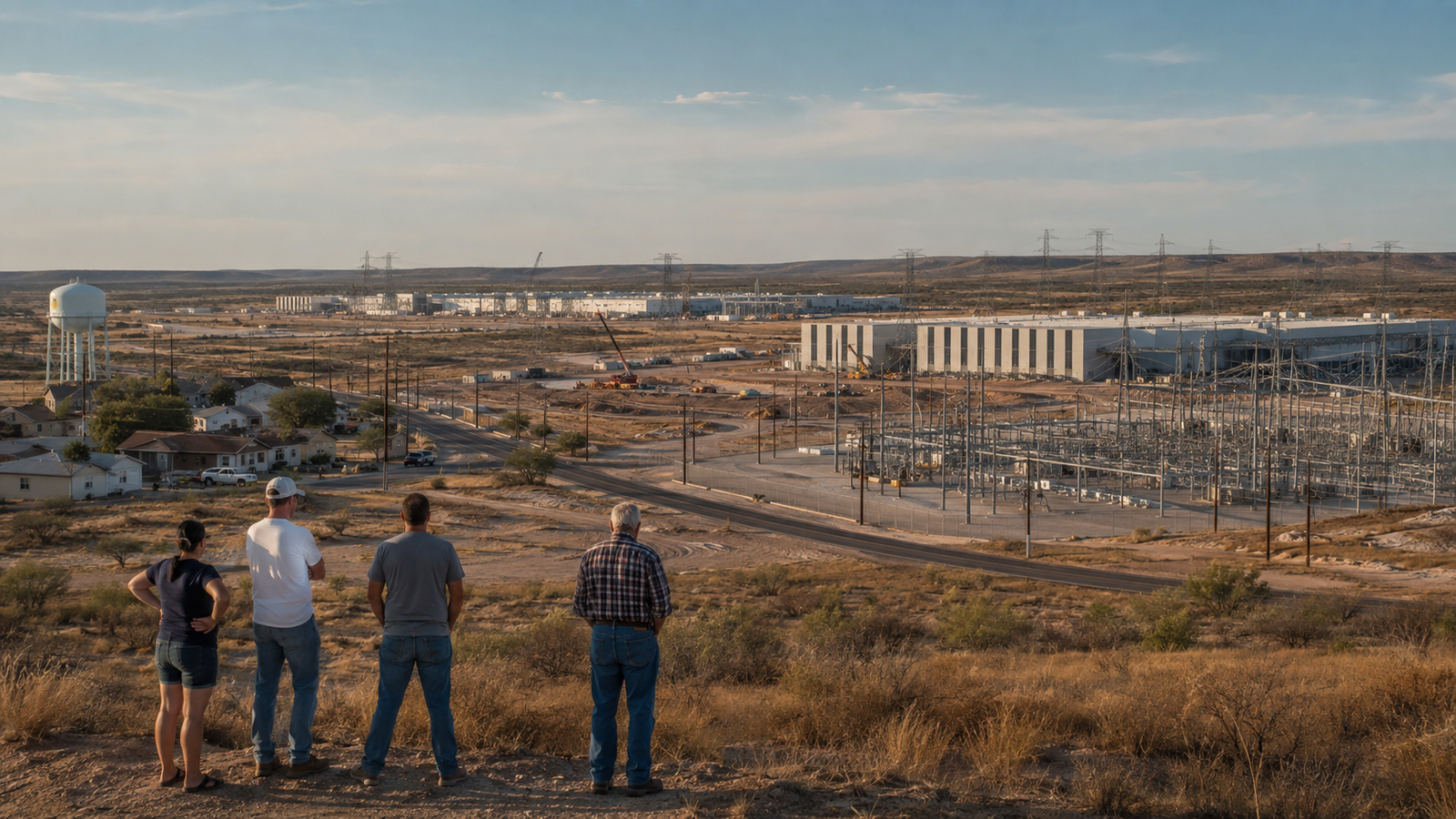
    AI may be global. Its infrastructure is local.

    The economic value created by AI may flow through products and markets around the world. The physical burden lands somewhere specific.

    A substation is built in one service area. Water is drawn from one system. Noise reaches particular homes. A tax exemption affects a particular budget. A cancelled load leaves assets on a particular grid.

    The Meta-BlackRock agreement shows that private markets are developing increasingly sophisticated ways to finance AI infrastructure. Communities need equally sophisticated ways to protect the public interest.

    The standard should be simple: project-caused costs should be assigned to the project, public support should produce an auditable public return, and local people should not be asked to insure private upside without knowing it.


    Principal sources

    Editorial disclosure: This article was developed with assistance from artificial intelligence. Its sources, claims and conclusions were reviewed by Immortal AI’s editor before publication.