NEWS & ANALYSIS | WORK & POWER
Across workplaces in the United States, Europe, Asia and Australia, artificial intelligence is moving beyond assistance. It is helping assign work, monitor performance, evaluate workers and shape decisions about employment. The systems differ. The central question does not: what does their introduction do to the people expected to work with them?
By Andrew McDonald · Immortal AI
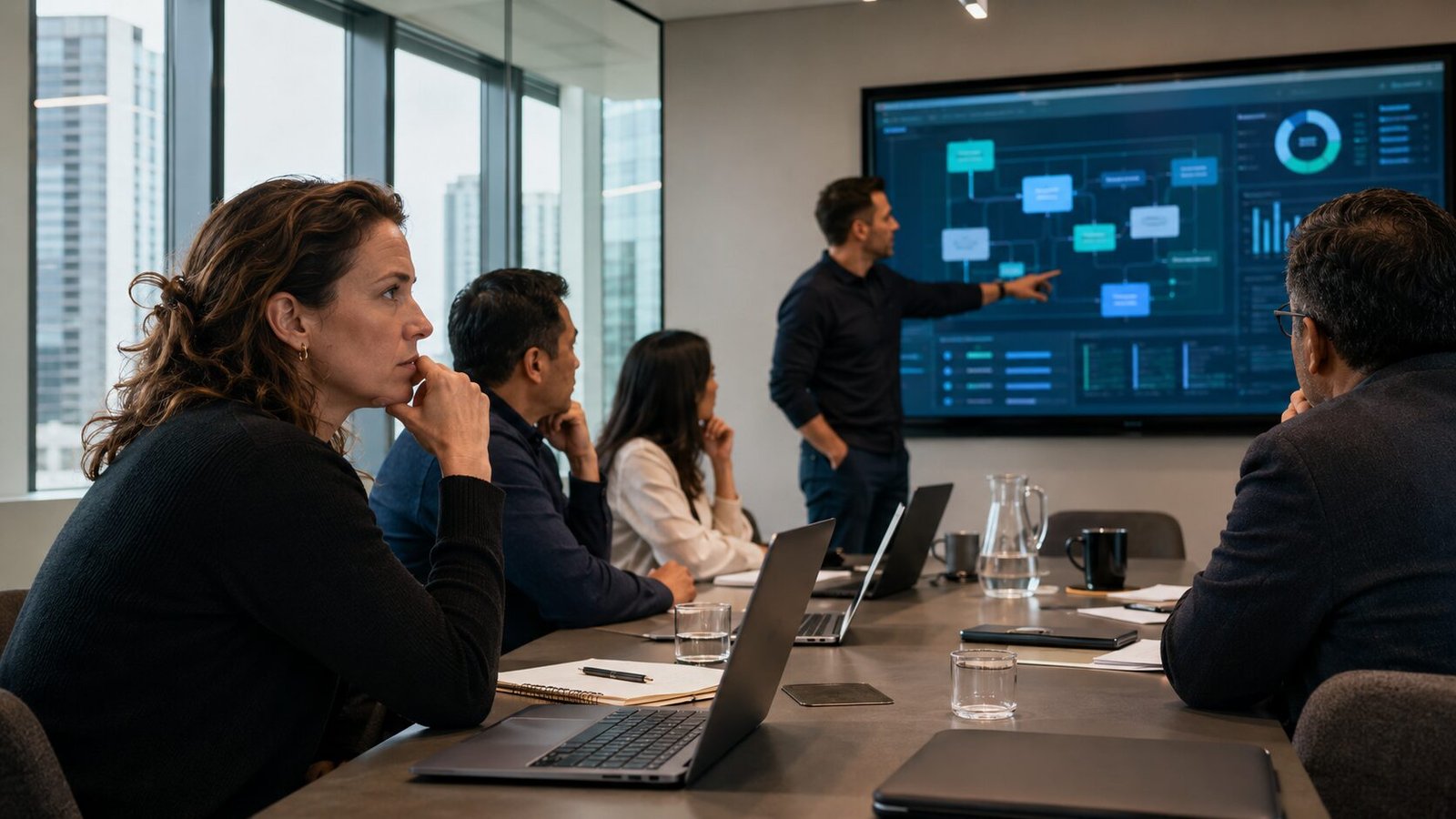
The new system usually arrives with a demonstration.
It can summarise meetings, draft reports, rank applications, allocate shifts, monitor performance or automate the routine parts of a job. Management talks about productivity. Workers receive a login, a short training session and perhaps a new target.
Then the less visible work begins.
Someone must check the output. Someone handles the exceptions the system cannot resolve. Simple tasks disappear while the difficult ones remain. A worker may be responsible for a decision they cannot explain, measured by software they cannot inspect or expected to achieve a pace calculated from an optimistic trial.
AI is not only an information-technology purchase when it changes workload, autonomy, surveillance, responsibility or the way performance is judged. It is a change to the conditions in which people work.
AI is already managing work
Algorithmic management is no longer confined to warehouses, delivery platforms or experimental workplaces.
An OECD study published in 2025 surveyed more than 6,000 mid-level managers in France, Germany, Italy, Japan, Spain and the United States. Seventy-four per cent said their firms used at least one software tool to instruct, monitor or evaluate workers. Reported adoption was highest in the United States at 90 per cent, averaged 79 per cent across the European countries surveyed and was 40 per cent in Japan.
Those figures require care. They are based on managers’ reports, and algorithmic management can include software that does not use artificial intelligence. They do not prove that every system is harmful or that every worker is constantly monitored.
They do show that automated management is already part of ordinary working life. In the same research, nearly two-thirds of managers reported at least one concern about the trustworthiness of the systems they used. The most common concerns involved unclear accountability, difficulty following the logic of decisions and inadequate protection of workers’ physical or mental health.
The International Labour Organization provides a wider measure of potential reach. Its 2025 global index estimated that one in four workers is in an occupation with some exposure to generative AI. The ILO’s conclusion was not that one in four jobs would disappear. Transformation of tasks was more likely than complete replacement.
That distinction moves attention from a distant argument about mass unemployment to a present question: how is the job changing now?
The work AI leaves behind
Automation is often described as removing repetitive tasks. That can be beneficial. A system that handles dangerous, tedious or administratively heavy work may reduce exposure to harm and give people more time for valuable tasks.
But removing simple work does not automatically make a job easier.
When routine tasks are automated, workers can be left with a greater concentration of work requiring sustained attention, judgement or emotional effort. Monitoring can support safety, such as identifying fatigue, but it can also increase pressure or become a performance-management tool. A system introduced for security can gradually be used to judge speed, tone, attendance or behaviour.
A flawed customer system may not only frustrate the customer. It can redirect anger toward the worker required to defend or repair it. A decision system may act quickly, but the person held accountable may lack the authority or information needed to challenge it.
Research reviewed by the OECD and ILO describes both sides of this change. Workers and managers can report better performance, reduced repetitive work and greater job satisfaction. The same evidence identifies work intensification, surveillance-related stress, privacy concerns, reduced interaction and doubts about automated decisions.
These outcomes are not inevitable. They are foreseeable design and management risks. That matters because a foreseeable risk can be investigated before harm becomes the evidence that something went wrong.
Different rules, the same underlying responsibility
Countries are responding through different legal and regulatory systems.
The European Union’s AI Act treats certain systems used in recruitment, worker selection, promotion, dismissal, task allocation and performance monitoring as high-risk. Its requirements are being phased in, and the exact obligations depend on the system and its use. The significance is broader than Europe: employment decisions are recognised as a setting where AI can materially affect a person’s rights and livelihood.
Australia offers a different example. In July 2026, Safe Work Australia published guidance stating that artificial intelligence and digital technologies can introduce or increase physical and psychological risks. Its central position is deliberately practical: those risks should be managed through the same workplace health and safety process used for other hazards.
That does not create one global legal rule. Labour law, privacy protection, consultation duties and enforcement vary widely between jurisdictions. In many places, regulation remains fragmented or incomplete.
But the management question travels. If a system changes workload, surveillance, autonomy, responsibility or exposure to harm, an employer cannot reasonably treat those effects as irrelevant simply because the product came from an external vendor.
Consultation is not an announcement
Worker consultation is one of the clearest points of agreement across the evidence.
OECD research found that training and worker consultation were associated with better outcomes for workers. Safe Work Australia says risks should be identified, assessed, controlled and reviewed in consultation with workers and their representatives. European rules create more formal duties for some high-risk uses.
Exact legal obligations depend on the country, employment arrangement and applicable workplace instrument. The practical reason for consultation is more universal.
The person doing the job knows where workarounds occur, which cases do not fit a standard process and what happens when a system is slow, wrong or unavailable. Excluding that knowledge can make an AI project less safe and less useful.
Consultation does not mean announcing a finished decision. Workers should be involved early enough to influence the design, not asked for feedback after the targets, vendor and operating model have been fixed.
Who receives the productivity gain?
There is credible evidence that workers and employers can benefit from AI. The OECD’s cross-country worker research found generally positive reports about performance and working conditions among workers already using AI. Managers in its later algorithmic-management survey also commonly reported improved decision quality and job satisfaction.
Those findings should not be dismissed, but they should not be overstated. Survey responses are not independent measurements of every workplace, and positive results in one occupation do not establish what happens in another.
The distribution question remains.
If AI saves a workday, is that time returned through lower workload, better service, learning or shorter hours? Or is the expected output increased until the person is busy again?
A productivity gain can become a safety risk if it is converted automatically into higher demands. It becomes a power question if the financial benefit flows upward while workers absorb retraining, uncertainty, surveillance and intensified work.
What a responsible introduction looks like
A responsible employer should be able to explain what the system does, what data it uses and what decision it influences. Workers should know when they are interacting with AI, when their activity is being monitored and whether the resulting information can affect performance management, rostering, promotion or dismissal.
The assessment should consider more than technical failure. It should ask whether workloads will change, whether complex work will concentrate, whether staffing assumptions depend on unverified productivity claims and whether disabled workers, carers, older workers, culturally diverse teams or people in insecure work will experience the change differently.
There should be a clear way to challenge an output and a person with authority to correct it. A worker should not be required to accept responsibility for a decision while being denied the power or information needed to review it.
Training should include the system’s limitations, not only instructions for using it. Time spent checking AI output is work and should appear in workload planning. Vendor updates should trigger consideration of whether the risk profile has changed.
Controls also need review. A safe pilot does not prove that the same system will remain safe when expanded to a larger team, linked to more data or used for a different purpose.
What workers can ask
A worker does not need to be an AI specialist to ask useful questions.
What task is the system changing? What information about workers does it collect? Who sees that information? Can it be used in performance or employment decisions? How was the expected time saving calculated? Who checks errors? Can a person override the output? What happens when the system fails? Were workers or their representatives consulted? When will the effects be reviewed?
Those questions do not oppose innovation. They test whether an employer understands the change it is asking people to carry.
Concerns can be raised through the channels available in the relevant workplace and country, including management, worker representatives, unions, safety bodies, labour regulators, data-protection authorities or professional advisers. Available rights and remedies will differ by jurisdiction.
The decision before the decision
AI debates often jump from possibility to outcome. Will it replace jobs? Will it make everyone more productive? Will it transform an industry?
The first responsibility is closer and more immediate.
Before the new target is set, before a performance score is trusted and before a role is redesigned, somebody must examine what the system changes for the person doing the work.
The global evidence does not support one simple verdict on workplace AI. It can remove danger, reduce repetitive work and improve decisions. It can also intensify work, extend surveillance and move responsibility onto people who cannot inspect or correct the system.
A workplace should not have to wait for exhaustion, unfair treatment or an incident to discover which version it introduced.
The tool may be new. The obligation to ask people what it will do to them is not.
Principal sources
- International Labour Organization: Generative AI and Jobs, a refined global index
- International Labour Organization: AI Systems at Work
- OECD: Algorithmic Management in the Workplace
- OECD: The impact of AI on the workplace
- European Union: Artificial Intelligence Act
- Safe Work Australia: New AI and digital technologies guidance
- Safe Work Australia: Managing AI and digital-technology risks
This article was prepared with AI assistance for research organisation and drafting. Sources were checked against the original publications. It provides general information, not legal advice. Editorial responsibility remains with Immortal AI.
Leave a Reply